

Understanding Secondary Math Pathways
Supporting Strong Long-Term Math Outcomes
Denver Public Schools’ K–12 Mathematics Instructional Vision emphasizes that students learn math best when the predominant lesson structure is an inquiry-based model and they are heterogeneously grouped Mathematics Instructional Vision Eng (A) . This vision reflects the district’s belief that students benefit from rich mathematical discourse, multiple perspectives, collaborative problem solving, and access to rigorous grade-level mathematics.
As students transition into secondary mathematics, families may have questions about acceleration and advanced coursework pathways. Pathway decisions should be made thoughtfully and with consideration for long-term student success, student readiness, mathematical identity, and access to meaningful mathematical learning experiences over time.
Understanding Acceleration
Acceleration refers to students accessing mathematics content at a pace that differs from the traditional grade-level sequence.
Research and district experience suggest that acceleration decisions are most successful when they:
Emphasize deep understanding over speed
Preserve opportunities for future access and flexibility
Thoughtfully consider students’ long-term academic experiences and goals
Support students socially and academically over time
Acceleration in middle school is not the only pathway to advanced mathematics coursework in high school. Families should note that high school courses taken in middle school do not count for high school credit.
Hamilton Mathematics Trajectories
The following examples illustrate possible secondary mathematics sequences.
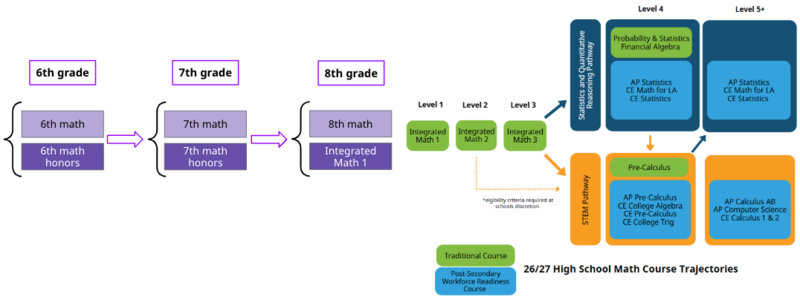
Hamilton Middle School is committed to ensuring that all students have access to rigorous and engaging mathematics learning experiences. While we prioritize deep mathematical understanding and flexible pathways over early acceleration alone, students at Hamilton have multiple opportunities to engage in advanced coursework throughout their secondary mathematics journey.
Our mathematics program is intentionally designed to:
Build strong mathematical foundations that support long-term success.
Keep future advanced coursework options open for all students.
Allow all students to move into advanced opportunities as their readiness and interests develop.
Prepare all students for advanced high school courses, including AP and college-level mathematics opportunities.
The pathway graphic illustrates that students may enter advanced mathematics coursework at different points in their journey. Students who begin with grade-level coursework in middle school still have access to advanced middle school and high school mathematics, including Pre-Calculus, AP Statistics, AP Calculus, and Concurrent Enrollment opportunities.